Your Next Coworker Never Logs Off: Muse, Dots, Duet and Grok Bot Are Racing to Run Your To-Do List
TL;DR
- Four AI giants now sell agents that keep working after you close the app. They differ less in smarts than in who they serve, how many agents you can run, and when they ask permission.

For years, using AI meant opening a chat window, typing a prompt and waiting. That habit is fading fast. In barely ten weeks, four big AI companies have launched agents that keep working after you close the app. They check your inbox overnight, draft the invoice you forgot and come back only when they need a decision.
The timeline is compressed. SpaceXAI, the company formerly known as xAI, opened Grok Bot in beta on Aug. 11. Meta followed on Sept. 8 with Muse, which it bills as “the world’s first personal AI agent built for everyone.” OpenAI introduced dots, its “always-on agents,” on Sept. 29. Anthropic announced a research preview of Claude Duet on Oct. 21, according to The Verge and CNBC; Anthropic’s own announcement page now carries an Oct. 23 date.
The shared recipe
The four products share a design. Each agent gets its own computer in the cloud, usually a virtual machine with a browser, so work continues when your laptop is shut. Each connects to apps you already use: Anthropic cites more than 6,000 connectors and plugins for Duet, and OpenAI says dots can reach more than 4,000 apps. And each promises to pause before consequential actions. Meta says Muse checks with you before sending an email or making a purchase; Anthropic says Duet waits for approval before it sends a message, makes a payment, signs a document or deletes anything.
Where they split
Muse is the consumer play. It lives in the Muse app, on the web and inside WhatsApp, targets everyday errands such as booking travel, filling out forms and shopping. Its most distinctive feature is a separate “Sentinel” agent on the same machine: Meta says nothing Muse does reaches the internet unless the Sentinel approves it. Mark Zuckerberg told analysts that more than 10 million people in the U.S. and Canada had set up Muse agents in roughly six weeks, CNBC reported.
Dots straddle work and home. They run in ChatGPT, Slack and Teams, use OpenAI’s Codex to build and test software, and come with Custom Rules that let you allow an action, require approval for it or block it. Today each person gets one dot; OpenAI says it envisions “teams of dots” later and is piloting “specialist dots” that carry their own company identity and credentials.
Duet is the most deliberately professional, built for professionals and small-business owners. It opens each day with a morning brief and hands back finished decks, financial models and dashboards. It is also the most candid about its limits: personal errands “aren’t quite as strong,” you cannot watch its browser, and it checks your accounts every few hours rather than nonstop.
Grok Bot leans hardest into orchestration. Instead of one agent, users create several Bots, each with a job such as sales outreach, expenses or bug fixes. They can message each other, share threads and coordinate in group chats, and SpaceXAI says its own staff often run several in parallel “with one to manage the others.” The trade-off is spelled out in Cursor’s security documentation: all of a user’s Bots share one cloud computer, so a login or file placed there is available to every Bot.
At a glance: four always-on agents compared
| Feature | Muse (Meta) | Dots (OpenAI) | Claude Duet (Anthropic) | Grok Bot (SpaceXAI / Cursor) |
|---|---|---|---|---|
| Launched | Sept 8, 2026 | Sept 29, 2026 | Research preview, announced Oct 21, 2026* | Beta, Aug 11, 2026 |
| What it is | Personal AI agent for everyday tasks and goals | Always-on agent inside ChatGPT | Proactive work agent (research preview) | A team of "AI teammates" (Bots), each with a job |
| Who it's for | Consumers; small businesses (Muse for Small Business) | Professionals and organizations; personal tasks too | Professionals and small-business owners | Individuals, teams and enterprises |
| Where you use it | Muse app (iOS, Android), muse.ai, WhatsApp; AI glasses "coming soon" | ChatGPT (web, desktop, mobile), Slack, Teams; texting in limited beta | Standalone iOS and Android app; claude.ai on the web | Desktop app (Mac, Windows, Linux); iPhone and Android apps |
| Model (officially stated) | Muse Spark; models trained with learnings from Muse Wonder rolling out | GPT-6 Astra; GPT-6.1 Terra added Nov 3 | Claude Opus 5.5 (no model choice) | Not named: xAI models, may use third-party; no model picker |
| How it runs | Muse Secure VM: dedicated cloud computer with browser | Own cloud computer and browser; laptop access optional (off by default) | Cloud VM with own browser; you can't watch or take over the browser | Persistent cloud computer shared by all of a user's Bots; local use optional |
| Orchestration / multi-agent | One personal Muse; a separate Sentinel agent gates what reaches the internet | One dot per person runs several projects and hands off Work/Codex tasks; specialist dots in pilots; "teams of dots" planned | One agent: a main thread plus topic channels and a Tasks tab | Many Bots in parallel; they message each other, share group chats, one can manage others |
| Approvals and safety | Asks before sending email or buying; audit trail; credentials hidden from agent; one-time Link cards | Custom Rules (allow, require approval, block); Auto-review; safety monitor can pause; password changes stay with you | Approval before send, pay, sign or delete; some actions banned even with approval; leak classifier | Approval requests; Auto Review on sensitive actions; Enterprise admin rules, DLP, network controls |
| Availability | US and Canada; Singapore since Oct 27; subscribers 18+ | Pro: 18+, excludes EEA, Switzerland, UK; Business Premium; Enterprise/Edu/Healthcare (admin preview Nov 4-18) | US only; waitlist invitations for Pro, Max, Ultra; not on Team or Enterprise yet | On paid plans (see cost); no country list found on official pages; computers run in the US |
| Cost (list, USD) | Free tier with usage limit; Power $20/mo; Maximum $100/mo | ChatGPT Pro $100, $200 or $500/mo (first dot included); Business Premium $125/user/mo ($100 annual) | Included in preview: Pro $20/mo ($17 annual), Max $100, Ultra $200; invitation needed | X Subscription Premium $30/mo, Super $100, Ultra $200; not on Free or Plus ($8) |
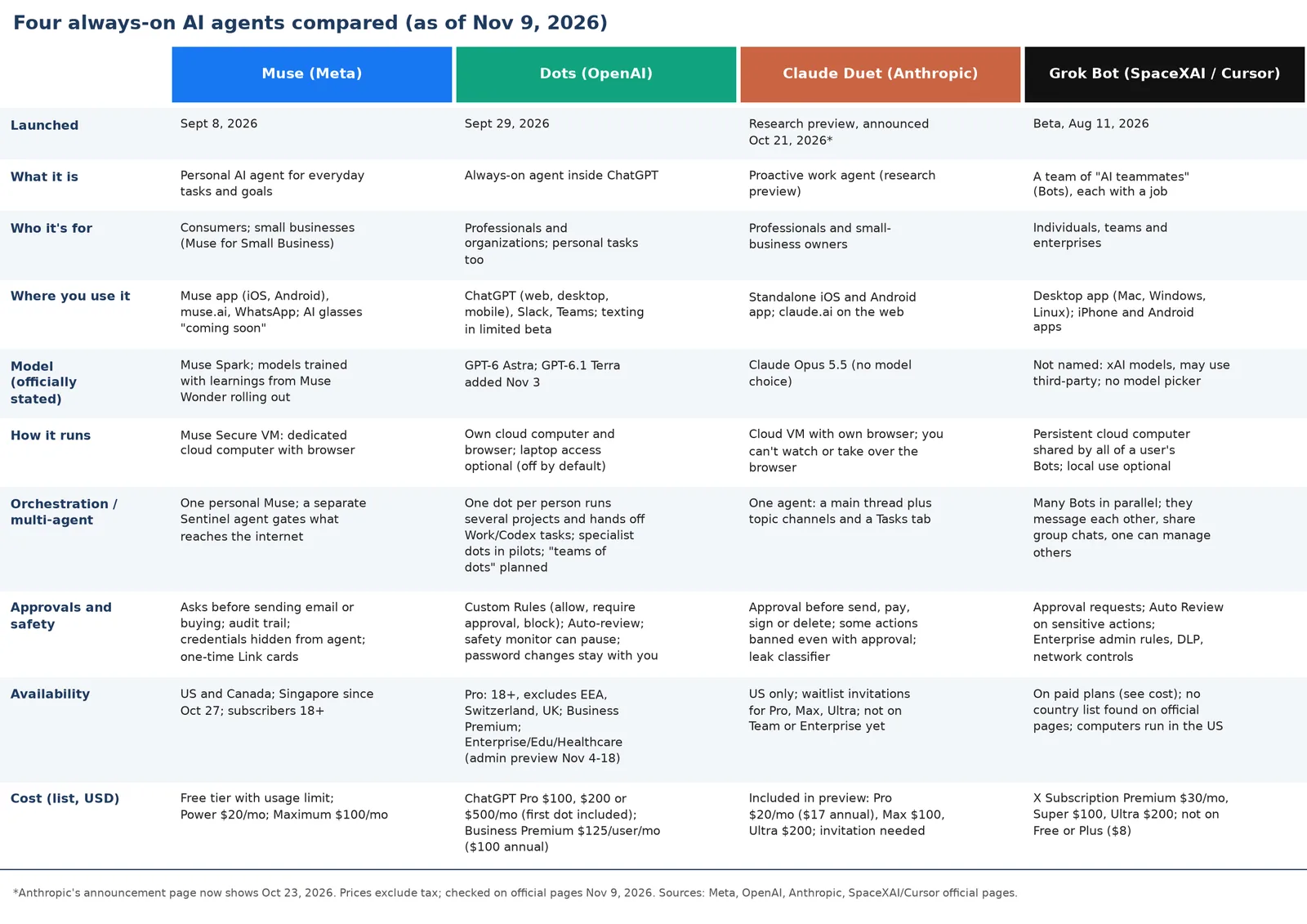
From one agent to many
That detail hints at where the industry is heading. OpenAI and Meta talk about agents working in teams; Grok Bot already ships one version of it. Once several agents share machines, logins and context, the hard question shifts from “Can the AI do it?” to “Which agent did it, under whose permission, and who checked?”
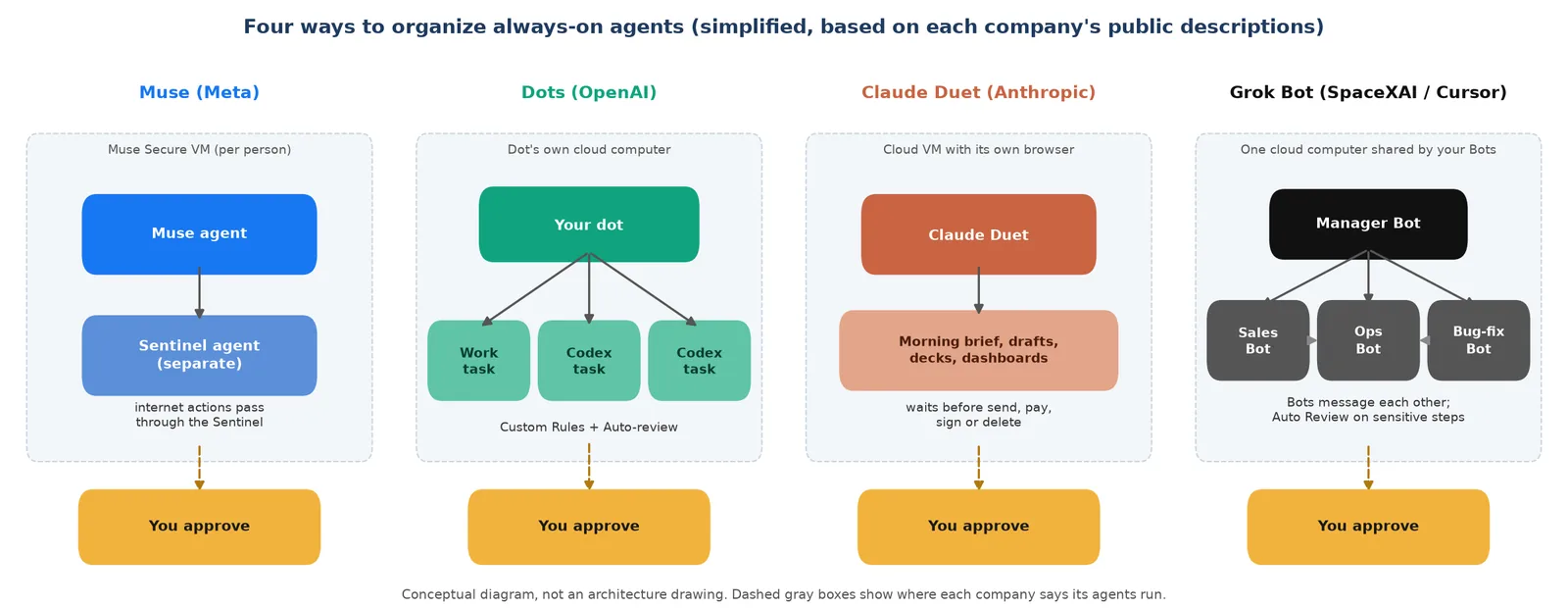
Their answers differ. OpenAI checks sensitive actions with automated review before they run, and Grok Bot can do the same. Anthropic uses its auto mode classifier plus a new filter designed to block leaks of card numbers and government IDs. Meta relies on its Sentinel. None claims to be foolproof: OpenAI says dots “can still make mistakes,” and Anthropic warns Duet may “miscalibrate what’s urgent.”
Price is the last big divide. Muse is free for most uses, with $20 and $100 monthly plans. Grok Bot starts with the $30-a-month Premium tier of The X Subscription. Duet costs nothing extra during its preview for Claude Pro ($20 a month billed monthly), Max ($100) and Ultra ($200) subscribers, but only U.S. users invited off a waitlist can use it. Dots require ChatGPT Pro, starting at $100 a month, or a $125-a-month Business Premium seat. All four meter heavy use, so the sticker price is only the starting point.
Why it matters for business and IS (analysis)
This section is opinion and analysis, not news.
Like it or not, AI agents are coming to work. Four of the biggest AI companies now sell them, and they plug into the email, files and business apps people already use. For business professionals, the question is no longer whether to use agents but how to manage them. More than ever, that means knowing what can be delegated and what cannot.
There is a dangerous line. Simon Willison, the developer who coined the term “prompt injection,” calls it the lethal trifecta: an agent with access to private data (email, files, CRM, HR records), exposure to untrusted content (any text or image an attacker can get in front of the model) and the ability to communicate externally (sending email, calling an API, even loading an image URL). Combine all three, he warns, and an attacker can trick the agent into sending your data to them.
Every product in this story can be set up to cross that line. An inbox holds private data and untrusted content at once, because anyone can email you. Approval screens help, but they depend on a busy person spotting a well-disguised request.
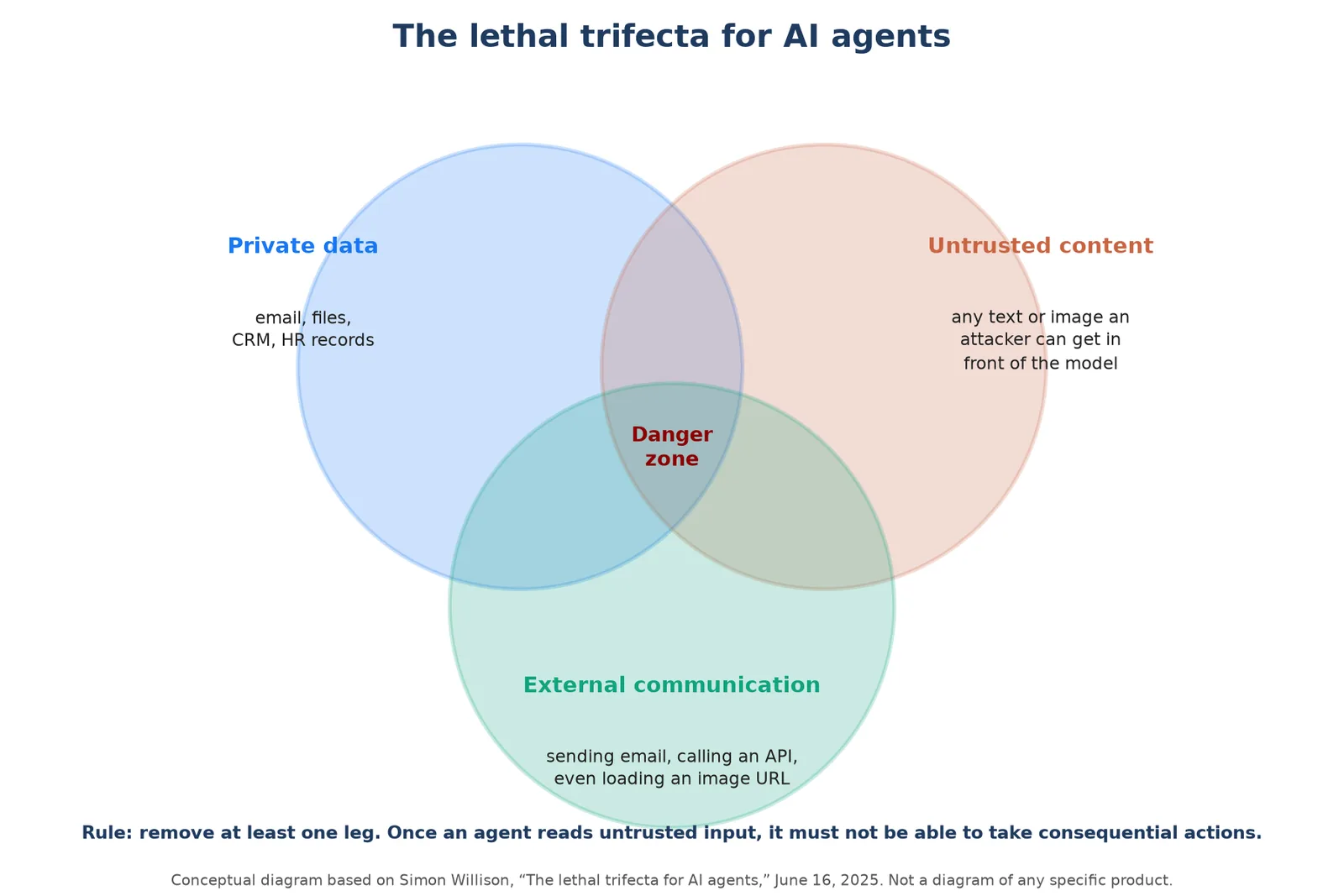
The rule is to remove at least one leg. Once an agent reads untrusted input, it must not be able to take consequential actions. That is the focus of today’s ISBA 4399 lecture: deciding, task by task, which data, inputs and outbound channels an agent gets, and never handing one agent all three.
Sources
- Meta. “Introducing Muse: The World’s First Personal AI Agent Built for Everyone.” Sept. 8, 2026 (updated Sept. 30). https://about.fb.com/news/2026/09/introducing-muse-personal-ai-agent/
- Meta Help Center. “About Muse subscriptions.” https://www.meta.com/help/subscriptions/1021145227643680/
- Meta. “The Future Is for Everyone: Muse for Small Business.” Sept. 29, 2026. https://about.fb.com/news/2026/09/introducing-muse-small-business/
- Meta. “Muse Is Now Available in Singapore.” Oct. 27, 2026. https://about.fb.com/news/2026/10/muse-is-now-available-in-singapore-the-worlds-first-personal-ai-agent-built-for-everyone/
- Meta. “Introducing Muse Wonder and Muse Wonder Full.” Oct. 12, 2026. https://about.fb.com/news/2026/10/introducing-muse-wonder-models/
- Meta. “Design the Muse App, Just for You.” Nov. 6, 2026. https://about.fb.com/news/2026/11/introducing-spaces-customize-muse-app/
- OpenAI. “Introducing dots.” Sept. 29, 2026 (updated Nov. 3). https://openai.com/index/introducing-dots/
- OpenAI. “Dots” product page. https://chatgpt.com/features/dots/
- OpenAI Help Center. “Getting started with your dot.” https://help.openai.com/en/articles/20001530-getting-started-with-your-dot
- OpenAI Help Center. “About ChatGPT Pro tiers.” https://help.openai.com/en/articles/9793128-about-chatgpt-pro-tiers
- OpenAI. “Premium seats are coming to ChatGPT Business.” Aug. 10, 2026 (updated Aug. 25). https://openai.com/index/premium-seats-chatgpt-business/
- Anthropic. “Introducing Claude Duet.” https://claude.com/resources/articles/claude-duet
- Anthropic. “Claude Duet” product page. https://claude.com/product/claude-duet
- Claude Help Center. “Get started with Claude Duet.” https://support.claude.com/en/articles/17631495-get-started-with-claude-duet
- Anthropic. “Claude pricing.” https://claude.com/pricing
- SpaceXAI. “Introducing Grok Bot.” Aug. 11, 2026. https://x.ai/news/introducing-grok-bot
- SpaceXAI. “Grok Bot” product page. https://x.ai/bot
- Cursor Help. “Grok Bot plans and billing.” https://cursor.com/help/grok-bot/plans
- Cursor Docs. “Grok Bot security FAQ.” https://cursor.com/docs/grok-bot/security-faq
- SpaceXAI Docs. “The X Subscription pricing.” https://docs.x.ai/x-subscription/pricing
- CNBC. “Anthropic announces preview of Claude Duet, a personal AI agent to take on Muse, Dots.” Oct. 21, 2026. https://www.cnbc.com/2026/10/21/anthropic-preview-of-claude-duet-personal-ai-agent-take-on-muse-dots.html
- The Verge. “Anthropic takes on Muse with Claude Duet, its new AI agent.” Oct. 21, 2026. https://www.theverge.com/ai-artificial-intelligence/1015843/anthropic-claude-duet-ai-agent
- The Verge. “Grok is now an AI ‘teammate’ you can assign work.” Aug. 12, 2026. https://www.theverge.com/ai-artificial-intelligence/978666/spacexai-grok-bot-ai-agent-beta-launch
- Simon Willison. “The lethal trifecta for AI agents: private data, untrusted content, and external communication.” June 16, 2025. https://simonwillison.net/2025/Jun/16/the-lethal-trifecta/
- Beurer-Kellner, L., et al. “Design Patterns for Securing LLM Agents against Prompt Injections.” arXiv:2506.08837, 2025. https://arxiv.org/abs/2506.08837
- CNBC. “Meta pushes into personal AI agents.” Sept. 8, 2026. https://www.cnbc.com/2026/09/08/meta-personal-ai-agents-public-reckoning-privacy-safety.html